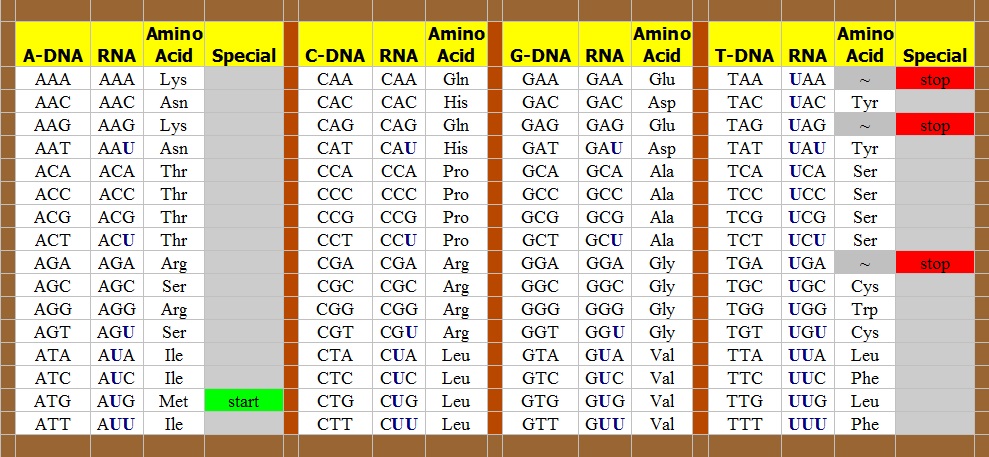
 The Genetic Code from DNA to RNA to Amino Acids Copyright image by Mike DeHaan, all rights reserved. My background in computer science and mathematics made the "code" part easy. I had to find some serious reference materials to answer "what is DNA?", and to describe the genetic code and its importance for DNA testing. As always, I promoted the Decoded Science article in my DeHaan Services blog. " Is the Genetic Code just another Binary Code like ASCII?" does not add much to the discussion, unfortunately. Research this one Writing Tip
This may be a new writing tip within this blog, although I hope that it's not a surprise if you read my Decoded Science articles.
The writing tip is: do the necessary research, and don't be afraid to pursue it.
Yes, I had already picked up enough background about the genetic code to recognize what I needed. But I needed solid references to DNA testing and genetic sequencing. I did find them, mainly because I limited my online searches to site:.gov and then to specific sites within the US government's health and sciences branches.
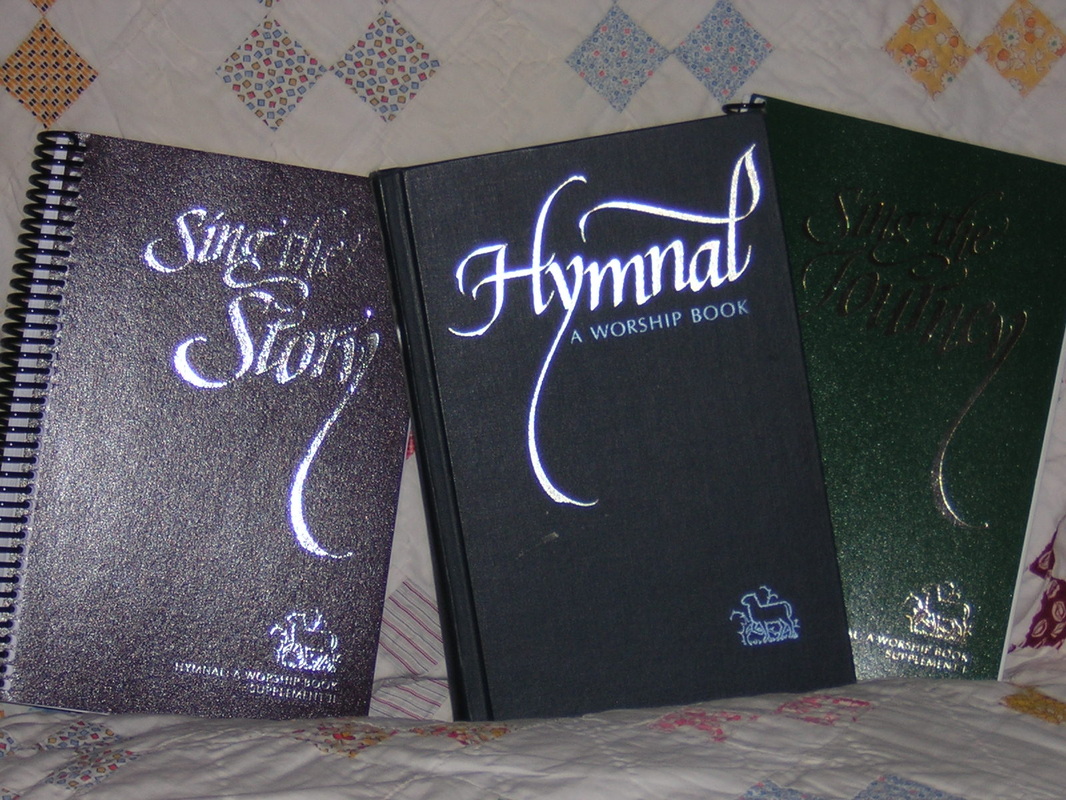 "Three Modern Mennonite Hymnals on a Quilt" image by Mike DeHaan
On Sept. 14, I decided to take an alternative approach to promoting the Toronto Mennonite Festival. My focus had been on the quilt auction, which may be a unique opportunity in Toronto. However, the festival also offers about an hour of 4-part singing in the Mennonite Meeting House. It's another building in Black Creek Pioneer Village, the venue for this whole event. So then I wrote a new article, " Mennonite Singing in Toronto at Black Creek Pioneer Village", to publicize that opportunity. I'd also updated the " Fun and Musical Activities" page in the Toronto Mennonite Festival web site.
This also gave me the chance to promote the three current Mennonite hymnals, shown in my photo above.
In addition, I mentioned the Junction Music Festival (on Dundas St. West) as well as the Manifest Live music and dance event at Yonge Dundas Square. After all, many of my DeHaan Services articles mention free or frugal events in Toronto.
One Writing Tip for Multi-Purpose Articles
I'd already written about the Toronto Mennonite Festival and its quilts in " Two Quilt Events at Black Creek Pioneer Village in Toronto". Why write about it again?
The first reason is that it deserves more publicity, since it's a good cause with a very limited budget for promotion. (Disclosure: My unpaid role is to promote it).
Secondly, I found another angle: the music rather than the quilts. Just as my "Two Quilt Events..." article multi-tasked for two events, so does "Mennonite Singing...".
Finally, my article multi-tasks by providing new keywords for advertising. The first article was all about quilts; this was about the music. In fact, I added Amazon links so Skimlinks could monetize any clicks.
So the writing tip for multi-purpose articles is to plan ahead! In my case, I needed to:
- Promote an event...
- Using new keywords to attract new readers...
- While monetizing my article with descriptions and links to products.
Thanks for reading about multi-purpose promotional articles!
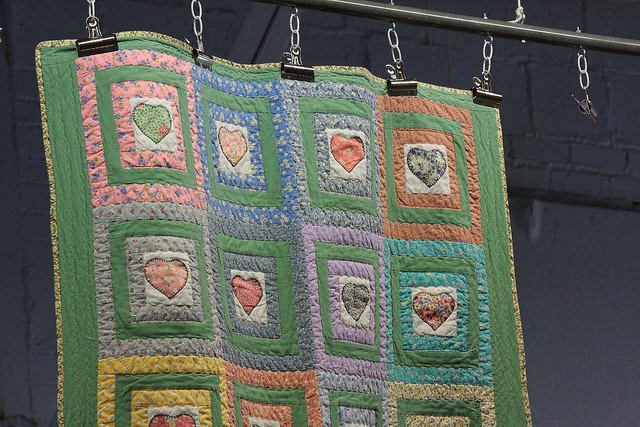 Back in August, I'd written " Two Quilt Events at Black Creek Pioneer Village in Toronto" to publicize two quilt shows. ["A Quilt Hung for an Auction" image by Les_Stockton].
Actually the first was a quilt show and sale called "Quilts in the Creek". Black Creek Pioneer Village partnered with York Heritage Quilters Guild in August 2014.
The Toronto Mennonite Festival runs its annual quilt auction on the third Saturday of September. The quilt auction is the major fundraiser that day, although they also sell very good food. This event, formerly known as "Black Creek Pioneer Village MCC Relief Sale", supports Mennonite Central Committee (MCC) financially.
MCC pursues "relief, development and peace around the world ". (That's relief as "famine relief" and "disaster relief", mainly in the Third World).
Disclosure: I serve on the Toronto Mennonite Festival board as a member of one of the supporting churches. I also sell Sloppy Joes (and a vegetarian version we call "Veggie Joes") at this festival. But I'm not paid for doing those things, and I'm not paid to advertise these events.
A Writing Tip for Disclosures
Today's simple writing tip is to include a simple disclosure when you write about something in which you have an otherwise-hidden vested interest.
If I were to write about "my DeHaan Services business", then it would be obvious that I'm promoting something for myself. I wouldn't write a disclosure because I would have said " Contact me for your writing needs"! If you blog about walking your own dog, it's overtly about you; but there's no need for a disclosure unless you also walk other people's dogs for a living.
In the above article, you'd never guess that I have any involvement in the Toronto Mennonite Festival... until the disclosure.
When I promote other events, I include a "no relationship" disclaimer. See what I mean near the end of "Find the Beach Celtic Festival 2014 in Toronto".
Thanks for reading about these quilt auction, show and sale events at Black Creek Pioneer Village in Toronto.
A Writing Tip for Joint Blogs
( Added Sept. 13, 2014). Part of my mandate with the Toronto Mennonite Festival is publicity; but that is shared with several other Board members.
I couldn't post the pictures of the quilts until the people who collect and store these items had photographed and e-mailed the images. Once I began posting them, an alert reader asked "What size are these quilts"?
Oops! That's important for people bidding on the quilts; but due to an oversight no-one told me.
This writing tip says: when you collaborate on a writing project, specify who gathers the information; what data is required; and then be sure that all the facts get to the writer.
By all means, scroll through the Toronto Mennonite Festival's quilt auction page to see the latest quilts donated to raise money to support Mennonite Central Committee's projects in development, relief and social justice.
 "Three Clocks Care Not for Daylight Savings Time" image by servus @ http://www.flickr.com/photos/servus/16117730/ "Three Clocks Care Not for Daylight Savings Time" image by servus @ http://www.flickr.com/photos/servus/16117730/ My recent article in DeHaan Services, " Make Time for 2014 Daylight Savings Time in Canada", is just in time for the change to DST in both Canada and in the USA.
It includes a note about changing the batteries in your smoke detectors, and a link to the whole world's scheduled dates for switching between DST and Standard Time.
I also mention doing some comparison shopping online for a brand-name alkaline 9 volt battery pack. Frankly, I was surprised that the web retailer's price was lower than the local hardware store's regular price.
I classify my article as a public service announcement.
One Timely Writing Tip for a PSA
Today's writing tip suggests a category for your blog.
Do you blog about handy tips and tricks? Do you cover current events? If your writing topics include facts or practical life suggestions, read on. (If you cover gossip, jokes, or your inner feelings... this category might not be for you).
Try including a PSA (Public Service Announcement) article in your blog from time to time.
One reason for writing a timely PSA, such as my Daylight Savings Time topic, is that there is a spike in readers looking for that information. News agencies and casual acquaintances mention a current topic, so they contribute the "buzz" for that news.
Another reason: the topic is right there in front of you. You may have been stuck for the theme for a blog post; but now you have your inspiration.
If you already are building a reputation for facts, helpful hints or practical suggestions for people to follow, then your reputation as a credible source lends weight to your PSA article.
On the other hand, it's not such a good idea to add one serious category to a blog that normally doesn't carry such themes. It's all a matter of building credibility as well as satisfying your audience. If they come to you for laughs or tears, they probably don't want to read your advice on when to set their clocks for Daylight Savings Time.
Thanks for reading about Daylight Savings Time in 2014.
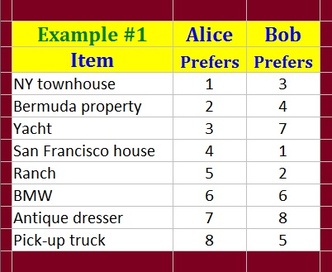 "Allocation Preferences Example 1" : Image by Mike DeHaan "Allocation Preferences Example 1" : Image by Mike DeHaan All my "Preview..." articles feature my original images that will appear in a future article in an online site which I don't own or control.
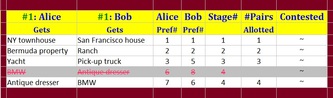 "Allocation Results Example 1" : Image by Mike DeHaan "Allocation Results Example 1" : Image by Mike DeHaan
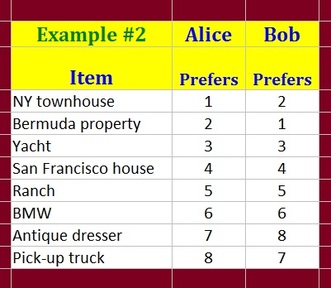 "Allocation Preferences Example 2" : Image by Mike DeHaan "Allocation Preferences Example 2" : Image by Mike DeHaan ( Updated): On Feb. 23, I updated this blog post with the link to my published article.
The point to writing an incomplete preview article is to publish my original images in one of my own web sites before they appear elsewhere. That establishes my copyright.
(Added Feb. 24, 2014): I've also written a promotional blog post in DeHaan Services. "How to Avoid Envy when Dividing the Spoils" adds some Canadian content because I'd interviewed one of the contributing authors, a professor at Wilfrid Laurier University.
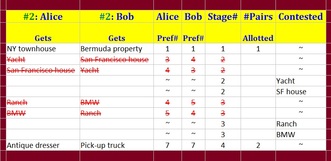 "Allocation Results Example 2" : Image by Mike DeHaan "Allocation Results Example 2" : Image by Mike DeHaan Now that the main article is published, I've added a writing tip to this blog post.
One Writing Tip on Useful Images
( Updated): Today's writing tip is a guide to adding useful images to an online article.
The basics: - Always have at least one image.
- Always follow the terms of use for images that you use from elsewhere.
- At least the first image should be eye-catching and creative.
- The images must contribute to the message or meaning of the article.
The above images that I made for my "How to divide..." article help explain the contents. But they aren't eye-catching, or especially creative.
Since I couldn't find what I wanted as the lead image, I asked my editor for help. I loved the image that was added to the article. It fit with the contents, but I would never have thought of it... or anything like it.
So this writing tip is to be sure to illustrate your articles with at least one terrific image. Use the images to explain your message.
Thanks for reading about dividing indivisible goods.
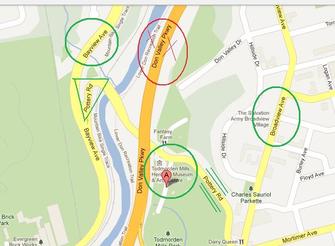 "Map of Todmorden Mills, Toronto" image by Mike DeHaan "Map of Todmorden Mills, Toronto" image by Mike DeHaan My recent DeHaan Services article, " Six Civic Museums for 2014 Family Day in Toronto", answers the question of what to do with this mid-February holiday. It continues my blog's series of annual frugal events in Toronto and the Greater Toronto Area.
One Family-Friendly Writing Tip
What's more "family-friendly" than saving time? That's today's writing tip. Save some time writing your next article by re-using existing artwork, illustrations or images.
Today I re-used two images for my DeHaan Services article. The map is one that I'd created for a previous article about an event at Todmorden Mills. (It's hard to describe the location with mere words).
The other image in that article is a great photograph taken at Fort York in Toronto.
The map is just plain useful for my readers; and the photograph has great aesthetic value. Besides, the Todmorden Mills section of the article is nearly at the end. By then, readers will have despaired of seeing any illustrations whatsoever.
Don't re-use images so often that your readers think they've read the article already. That's especially important if you cover the same topic with a new slant. But if you haven't used the image in a year or so, it's safe to re-use that picture.
Thanks for reading my article about celebrating 2014 Family Day.
 "Groundhog Not Afraid of his Shadow" image by Barbara L. Hanson "Groundhog Not Afraid of his Shadow" image by Barbara L. Hanson My recent DeHaan Services article, "A More Crowded 2014 Groundhog Day in Canada", reported that a mysterious new woodchuck plans to take her place in predicting weather on Feb. 2, 2014.
(Updated Jan. 31, 2015): I returned to this topic on Jan. 30, 2015. "Prepare for Groundhog Day 2015 in Canada and in the USA" covers the same wonderful cast of characters. But will they be more, or less, accurate with another year of preparation? Time will tell!
(Updated): I did learn more about Dundas Donna in Feb. 2014, and updated that article. In the meantime, it does point to a number of Canadian and American groundhogs who already have established themselves as weather predictors.
One Newsworthy Writing Tip for Groundhog Day 2014
I'd written about Groundhog Day previously, and had made a list of the sites to re-visit for 2014.
However, an evening newscast mentioned that Dundas Donna would make her debut this weekend. That launched my new article in time for Groundhog Day 2014: Feb. 2nd. My quick research then provided the specific angle: she's not just new, she is still shy about her appearance, her experience in weather prediction, and in booking appearances.
Today's newsworthy writing tip is to pay attention to news items. You cannot write about everything that popular media serves; but pay attention for issues that fit your niche. Dundas Donna, the latest weather-predicting woodchuck, should be an ideal celebrity guest at the type of event that I write about in DeHaan Services. Just keep alert for news about your interests, and find a way to write about those items.
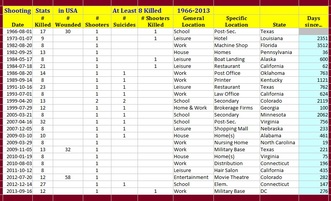 "Major US Shooting Incidents by Date" : Image by Mike DeHaan. "Major US Shooting Incidents by Date" : Image by Mike DeHaan. Welcome to this Preview article, in which I establish a copyright to images that I personally created.
I'm publicizing my upcoming Decoded Science article, "Trending Statistics for Major Fatal US Shootings", for which I created these images. (Now published!)
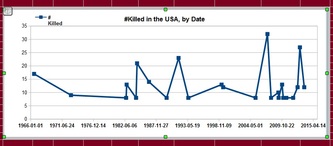 "Fatal US Shooting Incidents Graphed by Date" : Image by Mike DeHaan "Fatal US Shooting Incidents Graphed by Date" : Image by Mike DeHaan To establish copyright for a picture or diagram, I simply publish that image in a blog that I control, before sending it to another site to illustrate an online article.
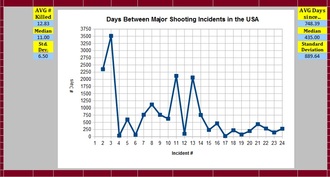 "Days Between Major Fatal US Shooting Incidents" : Image by Mike DeHaan "Days Between Major Fatal US Shooting Incidents" : Image by Mike DeHaan After that, I return here to publicize that article and add a writing tip.
I also publicize my article in DeHaan Services, and often add a Canadian note for my fellow citizens. Unfortunately "Statistical Trends on Major Shootings in the US and Canada" is still a bit of a work in progress; no-one has spoon-fed me a report on Canadian shootings.
Take a Writing Tip from your Editor
This is such a simple writing tip, that I can't believe I haven't mentioned it before.
I wrote the article because my editor at Decoded Science pointed out the topic and some references.
Remember that editors rise to their positions by virtue of having an instinct for readers' interests and worthwhile topics, as well as a professional ability to reduce cluttered prose. So take their suggestions seriously!
Thanks for reading about how I came to write about the statistics of major fatal shootings in the US.
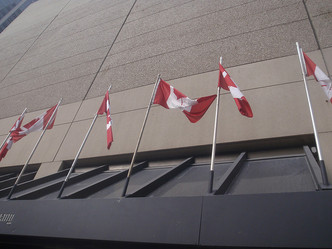 "Urban Canadian Flags at HBC" by PinkMoose (Anthony Easton) "Urban Canadian Flags at HBC" by PinkMoose (Anthony Easton) My recent DeHaan Services article, " When is the 2014 Family Day in Canada?", pins down the date s for this very diversified Canadian holiday.
Unlike national holidays, Family Day in Canada has different names and even different dates, depending on the province which celebrates or ignores it. Canada may pride itself on its diversity of people, cultural heritage and ethnic backgrounds; but we bring it to a new level in our treatment of this February holiday.
One Family Friendly Writing Tip
Okay, I admit that today's writing tip is only "family friendly" because the overall topic is "Family Day 2014 in Canada". Nonetheless, here it is.
I jumped at writing this article early in January although the holiday waits until mid-February. That's faster than my usual schedule.
Why the rush? I happened to read an ad promoting a Family Day activity just this past week. I thought, "If those people are already advertising, then I'd better get my article out in front of my readers".
So this writing tip is simple. If you see "your" topic being raised before you were ready, then you've nearly missed your opportunity. Be early, rather than late, to chime in with your unique viewpoints. After all, your readers deserve to find your best work, rather than someone else's, the first time they look for that information. And they might not bother looking a second time!
Thanks for reading about Family Day 2014 in
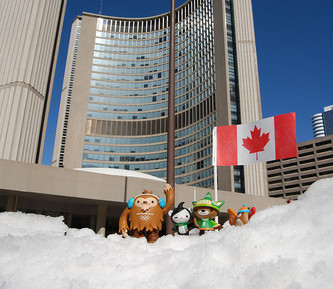 "Mascots at Toronto City Hall in Winter of 2010" image by happyworker "Mascots at Toronto City Hall in Winter of 2010" image by happyworker Start the New Year by " Finding Your 2014 New Year Levee in Toronto or in the GTA".
My DeHaan Services article explains what a "Levée" is, and lists a number of venues in the Greater Toronto Area (GTA) as well as in the City of Toronto, Ontario, where we can hobnob with dignitaries on either New Year's Day 2014 or on Sunday Jan. 5th.
Is This an Annual Writing Tip?
Certainly the annual tradition of holding a " Levée" lends itself to writing an annual article.
So if your blog deals, at least in part, with annual or recurring events, by all means write about them.
This may be my most common writing tip for inventing topics. If your topic comes up on some regular basis, you can plan ahead to research and write about it.
You probably don't want to put yourself on a treadmill; but most of us cannot invent completely new topics for each deadline.
While DeHaan Services specifically covers frugal annual events (among other topics!), you can find seasonal or recurring themes in many other niche markets:- Gardening;
- Home Maintenance;
- School versus Summer vacations Sports;
- Travel Destinations.
So spend some time thinking about your seasonal topics. Or go back over your blog, and see what recurring themes you've covered.
And thanks for reading about the 2014 New Year's Day Levées in Toronto.
|

 RSS Feed