The Simpson Reversal, aka the Yule-Simpson Paradox or Simpson's Paradox, is the situation where one competitor loses in each specific test, but wins the overall competition. My article in Decoded Science, " Detecting or Avoiding the Yule-Simpson Paradox", provides examples and explanations. By the way, the image below goes with the image in my self-promoting article, " A Guide to the Yule-Simpson Paradox", in DeHaan Services. 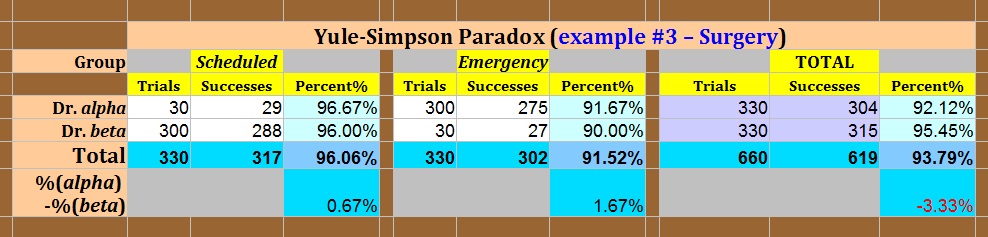 "Yule Simpson Paradox for Surgery" image (c) by Mike DeHaan A Writing Tip from my Simpson Reversal
The math of the Simpson Reversal is pretty simple, really. But, to be honest, I had to work hard to understand how it could happen in real life.
That brings me to today's writing tip.
You do have some great ideas to share, so go ahead and start your blog or write your article. But there's probably some part of it that's hard to understand. Sometimes examples are easy but the underlying principle is difficult. In other cases, like some moral issues, the foundation is straight-forward, but "the devil is in the details".
This writing tip says: take the time to wrestle through both the principle and at least one example. Different readers will find more value in one or the other of those various approaches.
Thanks for reading about the Simpson Reversal.
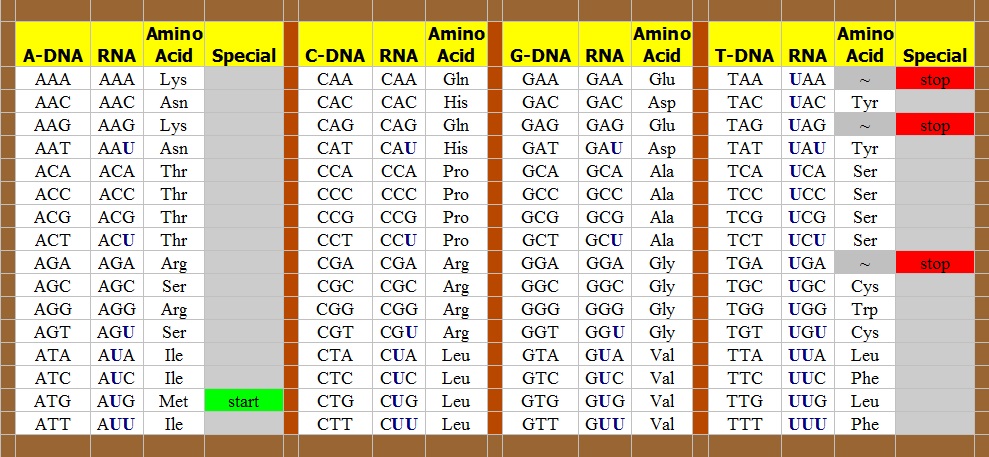 The Genetic Code from DNA to RNA to Amino Acids Copyright image by Mike DeHaan, all rights reserved. My background in computer science and mathematics made the "code" part easy. I had to find some serious reference materials to answer "what is DNA?", and to describe the genetic code and its importance for DNA testing. As always, I promoted the Decoded Science article in my DeHaan Services blog. " Is the Genetic Code just another Binary Code like ASCII?" does not add much to the discussion, unfortunately. Research this one Writing Tip
This may be a new writing tip within this blog, although I hope that it's not a surprise if you read my Decoded Science articles.
The writing tip is: do the necessary research, and don't be afraid to pursue it.
Yes, I had already picked up enough background about the genetic code to recognize what I needed. But I needed solid references to DNA testing and genetic sequencing. I did find them, mainly because I limited my online searches to site:.gov and then to specific sites within the US government's health and sciences branches.
My DeHaan Services website saw a prolific growth of four articles over five days. All revolved around Canada Day celebrations in Toronto.
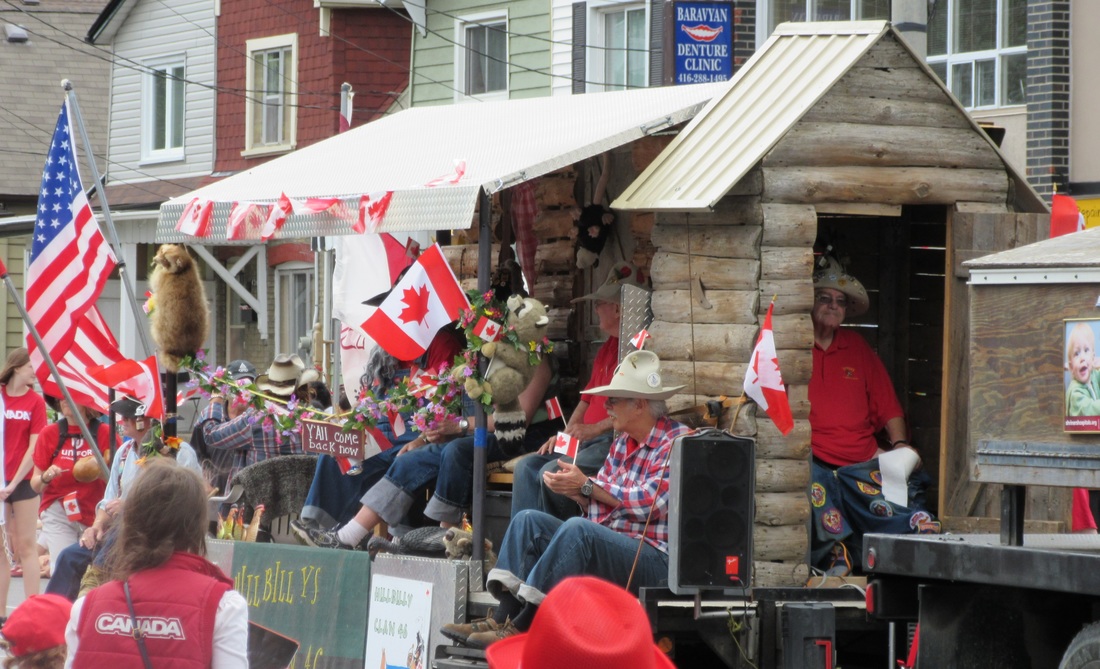 "Hillbillies parading with their raccoon" image (c) by Linda DeHaan.  "Canada Day Fireworks in Toronto at Ashbridges Bay #4" image (c) by Mike DeHaan One Writing Tip from Canada Day 2015
I'm sure I've mentioned the idea of using one inspiration for multiple articles, so that is not today's tip.
My writing tip today is to take your own photographs when you can. Sometimes I've taken as long to find images in the online photography sharing sites which have "share for commercial use" licenses, as to write the articles.
With a decent digital camera, including your cell phone, it's possible to take reasonably good quality photographs and transfer them to your web article.
Note that I've included "... image (c) by person" in the caption for each image. Publishing the image online, even in your own blog, establishes copyright by first public use.
One other trick is that you can edit the images you take with tools as simple as Microsoft Paint. For example, I cropped Linda's picture of the hillbillies. My main reason is that her camera put too many pixels into the image: my web site did not want to load such a large media file. But this also allowed me to remove a bit of background from the left side of the image. I cropped several of my fireworks photos to delete an annoying street light in the bottom right of the pictures.
You may not be able to take your own photographs to illustrate everything you write about; but it's worth taking advantage of the opportunities when they arise.
Plus, my wife and I enjoyed the outings.
Thanks for reading about my four 2015 Canada Day articles.
I don't often buy event tickets online, but the TO2015 PanAm Games in Toronto offers some once in a lifetime sports events for this city. This multi-sport, multi-venue event must be more difficult to set up for online ticket sales than concerts and single-venue sports. So I wrote " How to Find Tickets for the TO2015 Pan Am Games in Toronto" to pass along the tips that I discovered during this process. Here's a map that I made to show the path from the subway I would use to the venue for the sport. 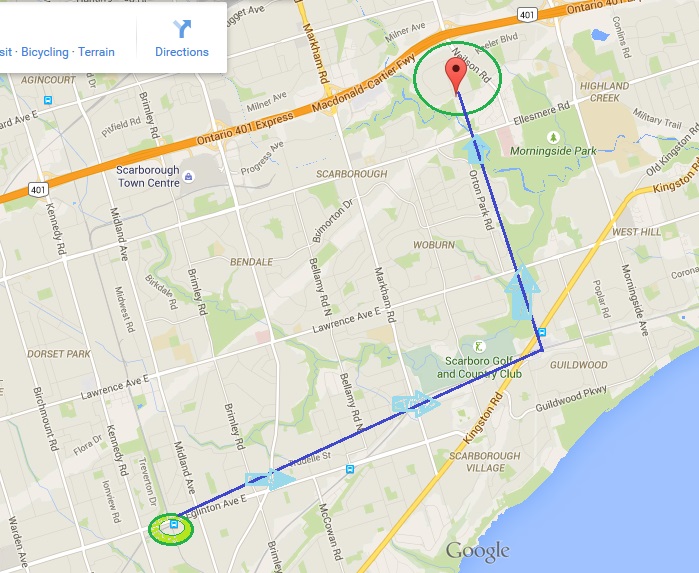 "PanAm Aquatics and Field House at U of Toronto, Scarborough Campus" image (c) by Mike DeHaan via Google Maps One Writing Tip Inspired by What I Learned Online
I've often said that one should be open to inspiration from many sources.
Today's writing tip is that the best inspiration for a self-help article is your own learning experiences.
The most valuable articles come from learning something that many other people will face, and that they would also find challenging. Will it save them time, effort and frustration? Then share your insights!
Thanks for reading about what I learned in buying tickets online for the 2015 PanAm Games in Toronto.
I wrote my DeHaan Services article, "2015 Oshawa Generals Victory Parade Route", because it was not easy to find that simple bit of information!
There was a significant deadline, too: today is one day after they won the Memorial Cup for men's junior hockey in Canada, and one day before the victory parade and celebration in Oshawa, Ontario.
 "Oshawa City Hall" image by Mike DeHaan via Google Maps One Writing Tip for a Victory Parade
Today's writing tip is an old Latin phrase: "carpe diem".
"Seize the day".
I have lots of other tasks today, but it's really important to publish a timely or "breaking news" story while it's still relevant.
The same applies to publicity: make it known now, or it won't matter in the future.
If your article is like a seat on an airplane... if the plane takes off before the airline sells a ticket for that seat... then it was worthless.
Your news article is worth something, especially if it's published in time for someone to take action.
"Don't delay - write today".
My recent "Find an Ontario Maple Syrup Festival near Toronto in 2015" was inspired by a televised news report, which explained a challenge faced by the local conservation centre in planning their upcoming maple sugar festival.
I did some research to verify what had been said, summarized it, and added pointers to several of the nearby maple syrup festivals in Ontario. For good measure, I also added a link to Amazon.ca for a Kindle collection of maple syrup recipes.
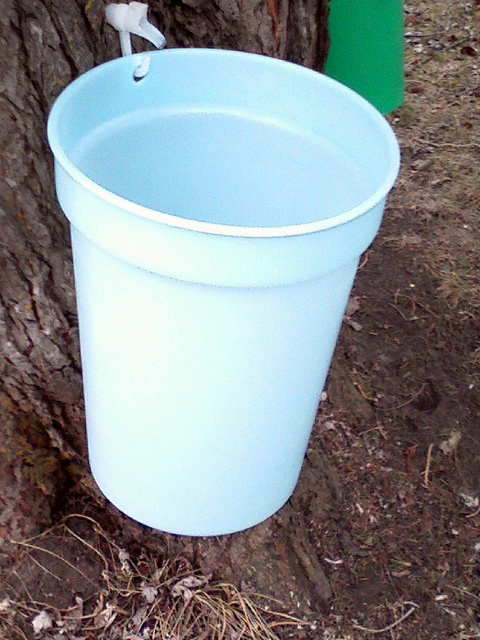
"Collecting Maple Sap for Maple Syrup" image by Bobolink (Robert Taylo) under CC license.
One Writing Tip made from Maple Syrup
I'm tempted to repeat an old writing tip: accept inspiration from any source; be open to noticing topics that you can use.
But here's one new writing tip, instead: once inspired, check the facts from another source before committing them to your own article.
In this case, the TV interview mentioned the weather conditions that challenged the upcoming festival. I knew that the information was accurate.
But I found a reputable online source anyway, double-checked the optimum conditions for harvesting maple sap, and linked back to that URL.
One reason is to ensure your own accuracy. Even if you quote some people directly, it's good to fact-check what they claimed, and note any errors they made.
The other part is to cite your authoritative sources, so your readers will know why they should trust your article.
Thanks for reading my article about several Ontario maple syrup fsestivals near Toronto in 2015.
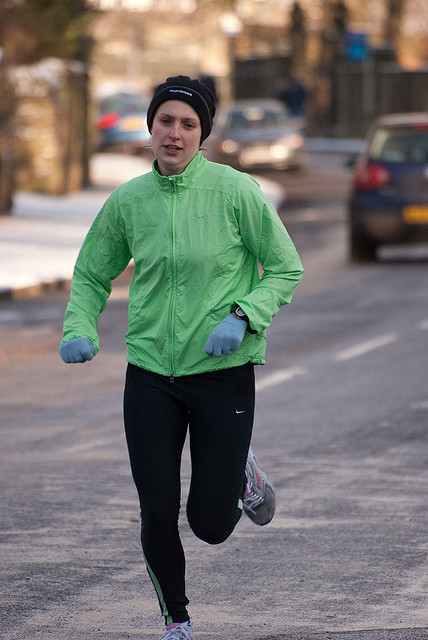
"A Halifax Harrier (UK) Demonstrates Cold Weather Running" image by AdamKR under CC license
One Writing Tip Adapted from Writing about Tips for Running
The inspiration for writing the article on cold weather running was that another runner didn't know one specific tip for running in cold weather. Perhaps he was just beginning running in winter; maybe he'd simply forgotten that one tip for running in the cold.
Then I realized that I use different writing styles in DeHaan Fitness versus DeHaan Services, which differs again from my writing for science or promotional copy.
Here's the writing tip.
Include some promotional notes, when appropriate, and especially in your main blog(s). By explaining why (and how) I change my "voice" in different situations, I'm pitching my skills to potential clients.
I applied one of my recent writing tips to the new pair of articles in DeHaan Services.
I had decided to get a jump on March Break in Toronto. (That may be better known as "spring break" in the USA. The province calls it the "mid-winter break", but no-one else seems to use that term).
Then I realized the 2015 March Break week includes St. Patrick's Day, so there were really two articles to write.
"Shamrocks for St Patricks Day" by puamelia under CC license.
The 2015 St. Patrick's Day Parade in Toronto 2015 March Break in Toronto
"Enjoy a Frugal Toronto March Break 2015" also starts on the weekend before the school holiday, because several of the special programs do start then.
Of course the main focus covers the week days; but some programs also spill over into the following weekend.
That's actually a great thing, since parents may have trouble taking time from work to escort their children during the work week.
To Repeat a Writing Tip
As soon as I noticed the first St. Patrick's Day event when I was busy researching the 2015 March Break events, one recent writing tip sprang to mind. In case you don't remember... and this was your last chance...
Research multiple topics at once, if they all pop up in the same source material.
In my case, one Toronto museum had planned some St. Patrick's Day activities; more had special activities for March Break.
So I decided to research both at once, keeping separate notes.
Although I haven't yet written about the museum event honouring St. Patrick's Day, it was quite productive for me to spend one session researching multiple topics. Probably more efficient that starting multiple "research, then write" sessions, in my view.
Your results may vary! What you might gain from studying one web site's variety of programs may be lost if your notes get sloppy. And it's not likely to help if you research multiple school assignments at once; not if you're trying to learn and explain new concepts in your essays.
But in some cases, you may find that researching several topics in one web site is efficient. There is a discipline, and your skill can improve, if you try it a few times.
Thanks for reading this writing tip, even if it's posted a second time because I researched the 2015 St. Patrick's Day Parade in Toronto at the same time as the 2015 March Break in Toronto.
Yesterday I published "2015 Chinese New Year in Toronto, the Year of the Sheep" in my DeHaan Services blog, barely in time for the Lunar New Year on Feb. 19.
However, I did learn something new in the process of writing about Chinese New Year 2015... more accurately, while updating my article.
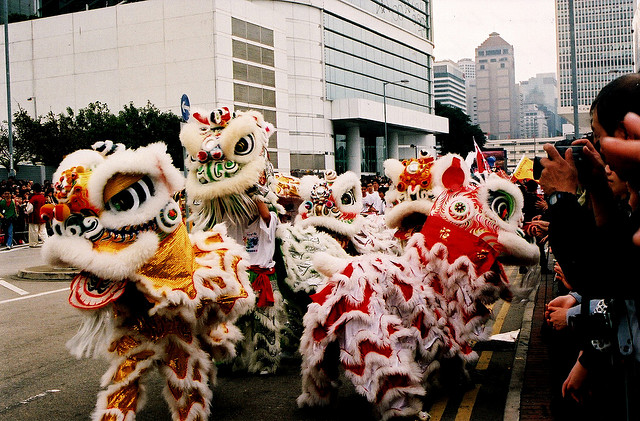 "Chinese Lion Dance for Chinese New Year 2009" image by Maureen Didde under CC license One Writing Tip from Writing an Article Twice
I learned my new writing tip because I was not satisfied with the original article. There were not enough events to make it worthwhile for my readers.
When I poked, rather desperately, at one of the resource sites that I use for some of my articles about events in Toronto, I found that they actually carried more information. And it was better organized in one section, for my purposes, than the sections I'd been using beforehand.
My writing tip for you is to look at your familiar source materials with fresh eyes, at least from time to time. Give yourself an unrealistically tight deadline, or just refuse to do things the way you've always done them.
You might not find a gem that way; but you surely won't find anything new unless you look in new places or in new ways.
This week, I'd begun research for a Valentine's Day article for my DeHaan Services blog. Since I knew that several civic museums in Toronto hold special programs for St. Valentine's Day, I began checking what they might offer.
Quickly I found that several Toronto museums also offer children's activities and projects for Family Day in Ontario, which also falls around this time. Bingo, there's another article to write!
I took notes for each holiday, and soon wrote a pair of articles.
"Two Toronto Museums for Valentines Day 2015" covers the one topic. Actually, they happen to offer somewhat similar approaches. You may be surprised at what they have in common.
"Enjoy the 2015 Ontario Family Day in 6 Toronto Museums" covers the other topic. Obviously it's more popular with museums in Toronto. One Writing Tip from Twin Articles
This writing tip encourages you to try breaking up your writing into two sections:
- Research.
- Writing
I didn't start with the idea of researching several related topics at once. The material I found just forced itself on me.
You can be smarter about it. Plan ahead, pick some related topics that you can research from a few places. Split up the information, then write each article.
|


 RSS Feed